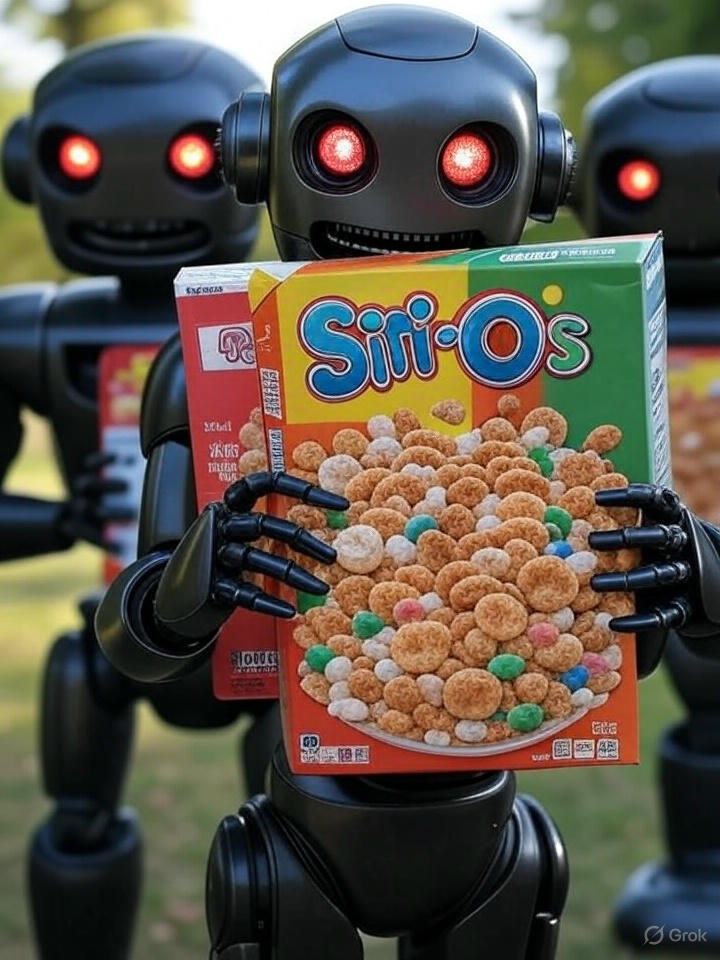
Search Engine Optimization (SEO) is a mature practice — around 30 years old for those of you who don’t want to be reminded. We all know there are watchful algorithms for the biggest things we do online, like engage in social media and shopping. Thus, there are SEOs for it all. I literally slapped my head when I realized there’s a practice of Amazon Search Engine Optimization. Ya dummy.
Smarter people than me note that we are increasingly relying on AI instead of traditional query-based search. A touch of laziness, sure, but we probably trust the Machine more than our own results, assuming that its large language models interpreting our wants can outperform our Boolean-ish queries.
But, what about our tangible world, the one made of atoms?
Out here, in the place of scents, flavors, and touch, we are all still the search engines, the RI – the Real Intelligences – that sort through the tangible environment.
You see a gorillion ads on your devices, but a grocery store assails you with tens of thousands of messages all at once. Thankfully, plan-o-grams allow us to chunk the information. For various reasons, Dairy is in the perimeter, almost always in the back corner opposite the main entrance. The shelves are divided by things like cow’s milk (usually on the left) to artificial creamers (on the right) and down to a few items from which you must choose.
Consumer packaging is big business, and one of those things in which we all have our opinions, our gray matter algorithms having their own large models of the aesthetically pleasing and sensible.
It is competitive, too. Average supermarkets stock around 50,000 SKUs. While many things in a Walmart Supercenter are not packaged (e.g., flower pots), the places carry about 140,000 SKUs.
Designed things are intentional. They’re made for reasons. Thus, most of walking a retailer is ignoring things that do not want to be ignored.
The Semiotic Layers Of Packaging
Packaging engineering is the discipline of using the fewest resources to achieve some transportation and storage aim, such as preventing breakage and spoilage. This place of engineering and materials science is the Base Layer of the semiotics of packaging. For most consumer packaged goods (CPG), there isn’t a lot of regulation, which means there’s relatively more room for aesthetic considerations.
That’s not the case with food or drugs.
In the U.S., the Code of Federal Regulations (CFR) Titles 9 and 21 are home to the rules, in all their agonizing detail and maddening opacity, regarding the inspection of food, food safety, and the packaging and labeling thereof.
It’s a lot, dictating things down to, say, the minimum proportions of the capital letter N in the Net Quantity Statement. (Width no less than one-third the height.)
And it is exactly the kind of thing The Machine breezes through. This is Layer Two, and it is bound by the restrictions of the Base Layer. If your package is made of M, is x,y,z size, and contains P product, the information on it must meet the appropriate standards.
Some classes of items, like meat, eggs, fish, and dairy, have more stringent rules than others. Nonetheless, elevated callouts like “organic,” or “gluten-free” evolve faster than the regulations, so there’s often some room for creativity and its ultimate purpose: positive differentiation. Things do not want to be ignored.
Manufacturers submit these callouts to organizations like NielsenIQ, which track the callouts via packaging images and uploaded data. “Protein” is popular right now. This is Layer Three and it is bound by Layer Two.
Layer Four, the aesthetics, is the part everyone notices. It is the branding layer, and it is also built within the limitations of the previous layers. No matter how cool your branding is, the Net Quantity Statement must be a certain size and in a certain place or Quality Assurance (QA) won’t let Production fire up the line. Before you can style “organic,” it must first be on the package in a way that FSIS, the Food Safety and Inspection Service (CFR 9, Ch. III), will allow.
There is a business waiting to be born in which AI develops and QAs the CPG.
As of now, Layer Four remains, in name, the province of the aestheticist. She takes a design brief from upstairs, and combines it with experience, her own aesthetics, and informed hunches to develop designs that must also satisfy Layers 1-3. While we all concede to Legal and Accounting their spaces, literally everyone has the very best sense of taste, ever, the inclusion of which for the sake of organizational comity can lead to sub-optimal design outcomes. Chefs and Chiefs. This is where AI and Package Design Optimization (PDO) come in. While traditional SEO involves humans changing characteristics to satisfy the algorithm in the digital world, Packaging Design Optimization will involve the Machine changing design characteristics to satisfy our mental algorithms in the tangible world.
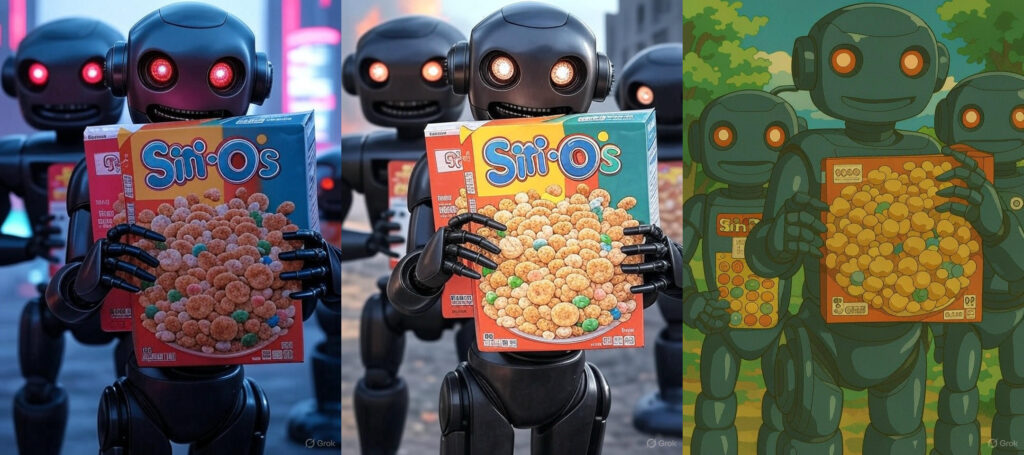
Here’s my prediction.
While there will be a risk of parties soaking up the Machine’s efficiency – “After all, it’s just a few clicks” – eventually, the Machine will brute force its way through even Layer Four. Its data is, theoretically, impartial.
Marketing will feed in-house branding data, competitors’ visual data, callouts, ingredients, and other prompts into the Machine, which will integrate it with register data that will provide input on demographics, but also tastes, as the Machine draws correlations between unrelated items. Buyers of L also buy K. Include K.
Over time, the Machine will iterate far faster than designers could. Marketers can then sort and rapidly test designs that already have a high probability of success to converge on package designs optimized for our collective aesthetics.
Aesthetic innovations disappear in masses. That’s why all our cars will periodically look the same, or why our entertainment becomes uniform and boring. (Netflix: “A former special forces mom … “) The Machine will accelerate this process.
There is hope. Tastes are fickle: people often reject ideas because others value them — a sort of anti-mimetic rivalry. It’s how you get Goth kids. Things do not want to be ignored.
Sriracha is no longer crowing from the rooftops. Hot honey will cool. Aesthetic changes, still guided by human desires, will first appear in branding manuals, then will be fed into the Machine, which will move along in the new direction, John and Jane Henrys of design in the rubble, Wacom styluses in hand.
But, not all of them.
Images courtesy of Grok.