
How CPG Products Might Be Found By Generations That Aren’t Looking
It’s a snap to put down a dumbbell and walk out of the gym. Swimming? I’m tired. I don’t want to drown. I get out. One of my favorite things about cycling is that you can conspire against yourself to go too far – seeing and experiencing more – and still make it back by managing your gears and energy.
A similar thing presents itself between searching online and searching in a physical store. Both online and brick-and-mortar environments optimize product placement, though online does so more aggressively because changing what is at the top of a Web page is orders of magnitude easier than changing a physical plan-o-gram. When combined with the ease with which a shopper can just put down the scrolling exercise and complete a transaction, we find that top-of-page really matters.
In contrast, if you have gone to a physical store and have worked your way into it, you must work your way out. Go to Costco on a Saturday, behold the long and terrible line, and what the heck, why not take a peek at the snacks? Though it has far fewer items than Amazon, that site provides tangible opportunities for happenstance, for discovery. Grab a sample. Online optimizes for things that you search for. The world brings you things you didn’t know you wanted. How many genuine Costco discoveries do you think happen online compared to walking around with a rotisserie chicken hanging off that funny hook on the cart?
Someone else came through here before.
Though it was built around violating property rights, Napster was the first digital shock to the music industry, peaking at around 80 million registered users before its legal implications shut it down. Napster angered the music industry, but was not an existential threat. Apple got that ball rolling with the iPod and iTunes, which made it easy to break up bundled work and actually use it.
In 2008, MySpace was the hottest social media property, doing quite a business with musicians because it allowed them to talk directly with existing fans and curious listeners. Spotify launched that year. With almost 700 million active users, Spotify is an Amazonian flood of competing products that can make discovery difficult unless you’re actively looking for new things.
Digital opened the world to new possibilities.. But, humans are pattern recognizers to reduce energy costs, and The Algorithms are human pattern recognizers to reduce transaction costs. The Algorithms reward similar and complementary purchases and habits. Especially habits. Discovery is anomalous, and therefore inconducive to habit unless it is deliberately built into the habit – like cycling a new route further than you should or spending time meandering through Costco.
Algorithms, on digital platforms that squeeze out margins, tend to create winner-take-all situations. Music creators adapted in at least three ways:
- Used social media to build relationships with fans and convert passive listeners.
- Created new products and product mixes like live streams that may be limited in time, that create connections and a sense of the special, and that can have higher margins. This is related to …
- Built a worldly presence, spending more time in front of more people creating in-person experiences.

Consumer packaged goods (CPGs) have a problem.
New, indy CPG brands need to understand that what was the most important way to get discovered is less open to them – not just because goliath food companies and private labels hold the most searchable shelf space, but because The Young Folks are searching in physical stores as little as possible. Younger generations do not like physical stores:
Curbside pickup is so popular among young shoppers, 86% of Homelanders [GenZ and GenA] and 76% of Millennials use it at least once a month, and about 25% rely on it weekly. In stark contrast, 51% of Gen Xers and Boomers have never used curbside pickup at all.
We can benefit by looking at what the music industry did and find other, more profitable ways to be discovered by and engage with shoppers. Oh, and by “engage” I don’t just mean like and share. I mean people put our food in their mouths.
Let’s say we are the truly brave ones. In fact, we lack a certain sense of … self-preservation.
We’re taking a new canned beverage to market.
A lot of new products, (e.g., high-protein breakfast cereal) are designed around a niche with dreams of expanding to the general market. I’m not going to pretend to be a social media expert, but the niche approach works well because it is complementary with tribes. Coke vs. Pepsi is a habit, not a debate. Nobody ever said no to the question, “We don’t have Coke. Is Pepsi ok?”
Because niches are complementary with tribes, they are also complementary with influencers and micro-influencers who can return a pretty good ROI within their domain of expertise. If we can get, say, an East Asian focused mommy blogger to promote our new canned beverage we might do pretty well … as far as it goes.
Younger generations are more receptive to social media than to traditional media, particularly with influencers and brands that actively provide value. So, we’re on the right track. And, one of the nice things that social media has over traditional promotional channels is that it is consumed on a device that is itself capable of completing a transaction right then and there.
A high ticket item with deep emotional appeal like a skin cream can overcome delivery costs. A digital product needs no wait and has zero delivery cost. But, hardly anyone is going to have a new organic, prebiotic can of fermented tea shipped to them. So, we are still faced with the problem of getting food into mouths when we are trying to grow our distribution.
Place
Remember that our musician friends now engage more in the world. In addition to looking at promotional channels that are cost centers, we might also look into alternative placement channels that allow us to be discovered while generating revenue.
Take for a wild example, an airport vending machine. It’s a relatively low-cost capital investment that also functions as a 24/7 billboard and revenue-generating touchpoint.
We wouldn’t be asking thirsty or bored people to choose us on the shelf over the Scylla of RedBull and Monster vs the Charybdis of Coke and Pepsi, or the top 12 items on Instacart. We’d be asking them to choose us over high-priced airport food, and the risk that they’ll miss their flight waiting for their order. Lot o’ people will make that choice. With the right tech, we could even pull some demographic data. B- or C- airports that might have fewer amenities might be good options. We do as the vending entrepreneurs do: pick up one, see how it works, then add another. Gather data.
Since our organic, prebiotic beverage is also nootropic, maybe we should put a vending machine in the apartment buildings around colleges and universities. Everyone wants that edge for finals.
The important thing is that we’re enabling the possibility of tangible, food-in-mouth discovery where we can test for product-market fit at relatively low cost.
We could link arms and ride coattails, by, say, partnering with small, upstart chains, home meal or direct-to-consumer meat or produce companies … even as a lagniappe. Maybe we can partner with complementary startups to do pop-ups or food trucks. We could run a special with ghost kitchens and catering companies. They’re always looking for that special, share-worthy touch. RedBull built a following in action sports. We could partner with youth sports – particularly the ones with die-hard parents, such as dance and gymnastics.
Obviously, we’ll want to enter into the big leagues, even if our brand might be better suited to C-stores than mass retail. Every RFP I’ve ever seen wants to know if you have customers. Here’s how we get our first ones while we figure out who our customers really are.
We shouldn’t forget to put a QR code on our cans, not only for likes and shares – there’s nothing wrong with likes and shares – but so that one can can lead to purchases where our other cans are sold.
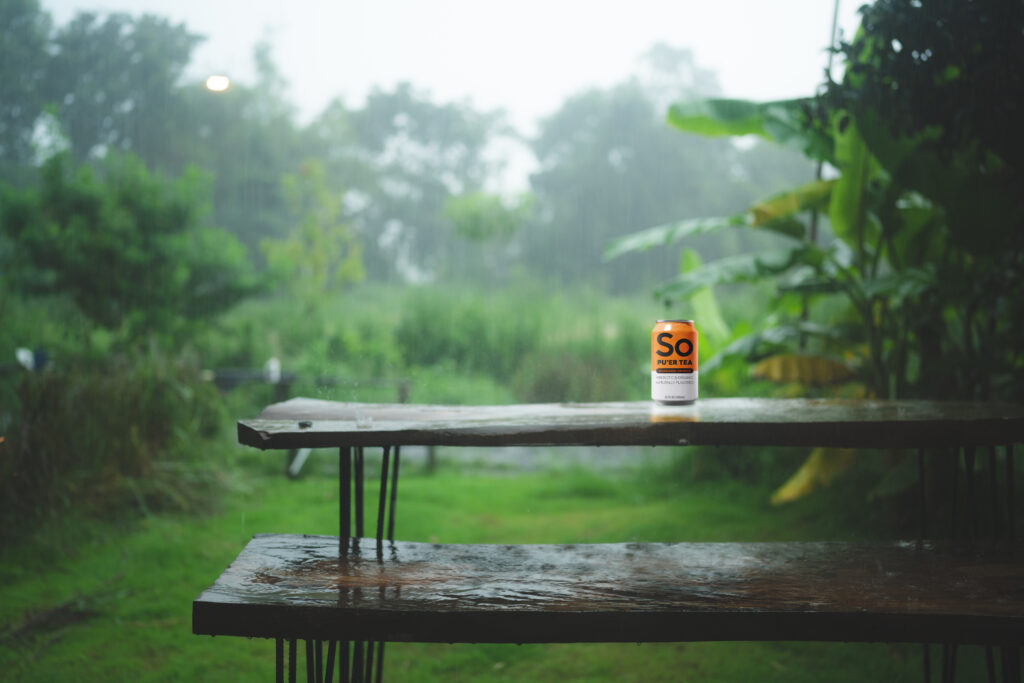
So Pu’Er Tea is a fictional beverage I created and designed for this article.